Upcoming Events
April 27th
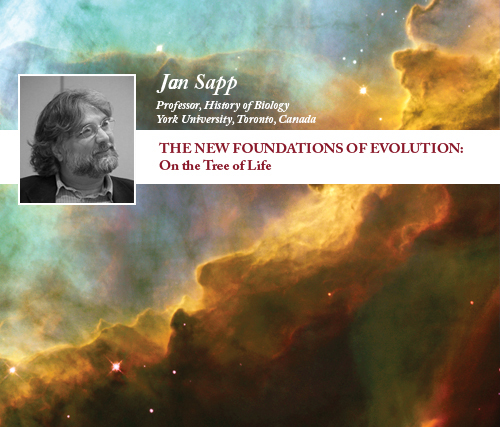
Jan SappProfessor, History of Biology, York University, Toronto, Canada
The New Foundations of Evolution: On the Tree of Life
4:00pm @ 101 Armory
Past Events
April 13th
Forest RohwerProfessor, San Diego State University
"Natural Selection" Revisited: Are There Really Winners in Evolution?
4:00pm @ Loomis 151
March 1st
Rudy RaffDistinguished Professor of Biology, Indiana University
Microbes and Fossils: Hunting the First Embryosbr />
February 17th
Ed DeLongDepartment of Biological Engineering, MIT
Illuminating the Microbial World: The Key to Understanding the Evolution and Ecology of the Living Earth System
November 2nd
Thomas Roy DaviesAuthor and BBC Producer, Director, and Writer
The Darwin Conspiracy
October 12th
Laura LandweberProfessor of Ecology & Evolutionary Biology at Princeton University
The Evolution of Cellular Computing: A Modern Take on Lamarckian Inheritance
September 30th
George DysonHistorian and Philosopher of Science
Von Neumann's Universe:
Computers & Beyond
September 29th
George DysonHistorian and Philosopher of Science
Darwin Among the Machines:
From Zoonomia to Artificial Life
|
Chancellor’s Colloquium on Evolution: Biology and Beyond Just over 30 years ago, here at the University of Illinois, Carl Woese and colleagues set out to chart the evolutionary relationships or family tree, if you will, of living organisms. They made the groundbreaking discovery that there are three domains of cellular life, not two as had been previously thought. This discovery, and the way in which it was made, has transformed evolution into a quantitative, empirical science, and impacted biology in ways that are still unfolding. Part of the legacy of this pioneering work is the dramatic visualization of evolution in action through the so-called “Tree of Life”, first constructed by Woese’s team. As you view, perhaps for the first time, this remarkable construct of evolution in action, ask yourself: what does it really mean? Is this the record of a collection of unrelated historical accidents, a mere progression of forms? Or is there a dynamical process at work, which somehow reflects the complex interplay between organisms and their environment, between the genome and organismal characteristics, .and between the flows of energy and information? And is the evolutionary process one that is unique to organic life, or a reflection of deeper physical principles that might extend to other realms of knowledge? The unprecedented public interest in evolution during 2009 is being driven by numerous special anniversaries: 150 years since the publication of the Charles Darwin’s Origin of Species; 200 years since the publication of Jean Baptiste de Lamarck’s Philosophie Zoologique, and 151 years since the first publication in a learned scientific journal of what has come to be known as the theory of natural selection, by Alfred Russel Wallace. But despite all that we have learned during the 19th and 20th centuries, what do we really understand about evolution today? Are the foundations of the subject now so well-understood that only incremental work remains to be done? And is evolution only a small, but highly controversial, arcane corner of biology, disconnected from the rest of scientific thought, and of primary interest only to theologians, school education boards, and philosophers of science? |
|